- Institute for Postnatural Studies
- Posts
- Eternal spring and a non-perishable learning curve
Eternal spring and a non-perishable learning curve
In rethinking what is a contemporary academy, we are met with a fascinating realization: learning has no end date, it doesn’t expire. It might, every so often, need to refresh.
This April, we host our most introductory course, and also a freezing (or melting?) seminar on water politics. Last chance to register!
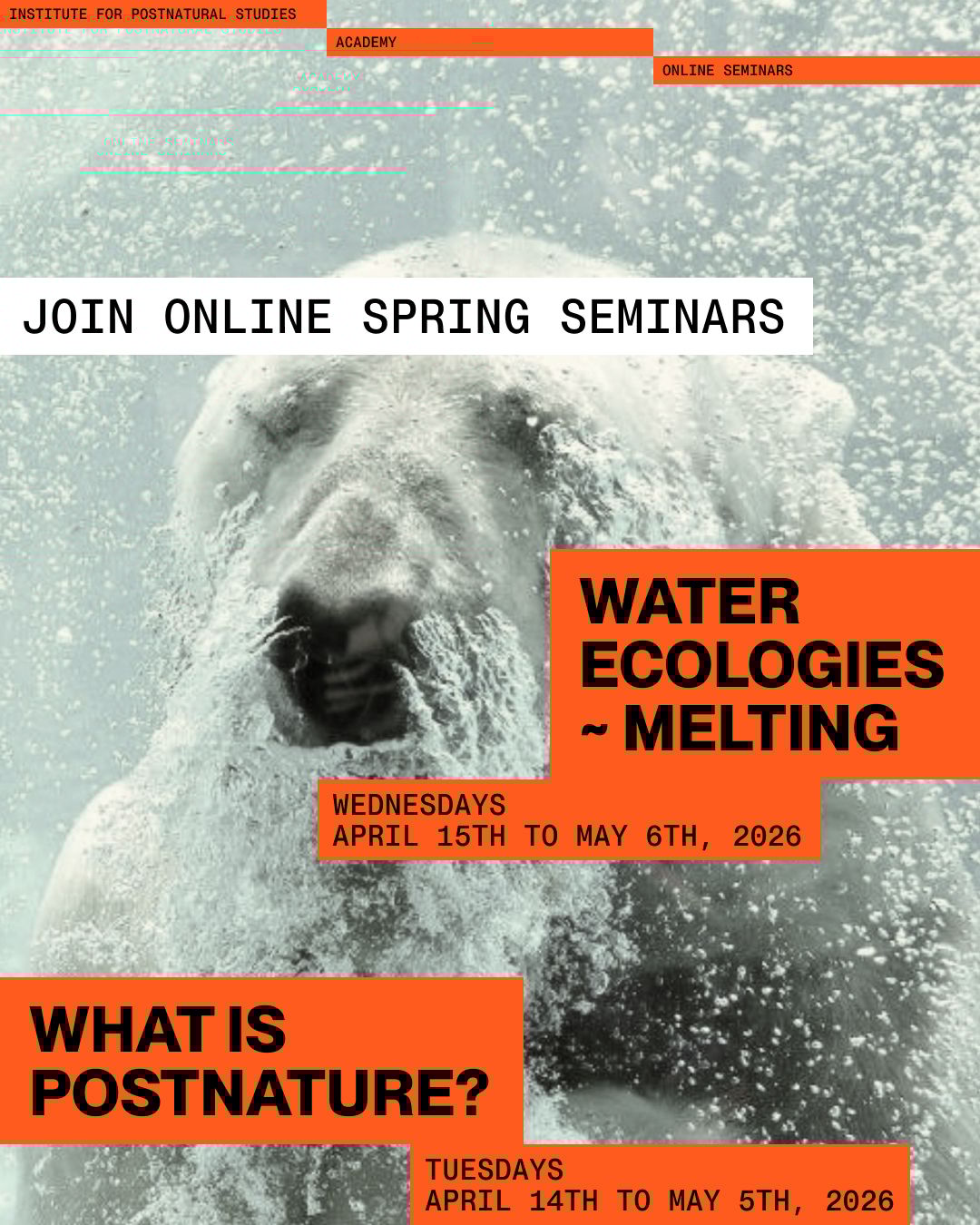
Both seminars fully held online. Once a week. In English, via Zoom. Courses can be booked individually or as a bundle. Alumni fee reduction available.
WATER ECOLOGIES ~ MELTING explores melting as a political condition, an atmospheric reconfiguration, and as a possibility to sense how human and more-than-human communities are capable of reaffirming life in these conditions. Led by Juan Pablo Pacheco.

WHAT IS POSTNATURE? invites participants to revisit the foundational questions and frameworks of our research platform, offering an opportunity to reflect on its core approach and underlying concerns. Designed for anyone engaging with ecology today. Led by Gabriel Alonso and Yuri Tuma.

Reminder: ALTERNATIVE ECOLOGIES (ALT–ECO) postgraduate program (Sep. 2026 - June 2027)
Applications open until May 17 for regular enrollment and scholarships
Open to artists, designers, researchers, and practitioners of all backgrounds willing to learn alongside world-renowned faculty, critics, and artist studios. Share your practice in a carefully selected cohort of 20–25 participants from all around the globe.
Deadline to enroll: May 17, 2026 (23:59 CET – Madrid time)
Latest coverage to catch up on:
With LEARNING CURVE, Catherine Taft shares via Artforum about the multiple pathways of growth and postnatural thinking embedded in the IPS experience and the upcoming ALTERNATIVE ECOLOGIES postgraduate program. She asks:
“What does it mean to adopt the mantle of “institute,” particularly in a moment of acceleration, specious facts, artificially generated realities, and fake news? Why would a collective so invested in radical skepticism, speculation, and embodied teaching want to flirt with the hoary schemas of knowledge, even as a name game, and risk a reterritorialization of power that imitates the very systems they seek to upend?”
